Quartzite vs. Engineered Quartz vs. Granite: Comprehensive Stone Durability & ROI Review
Authoritative mineralogical analysis of countertop materials: Mohs hardness, thermal shock thresholds, resin yellowing, acid etching, and fabrication pricing.

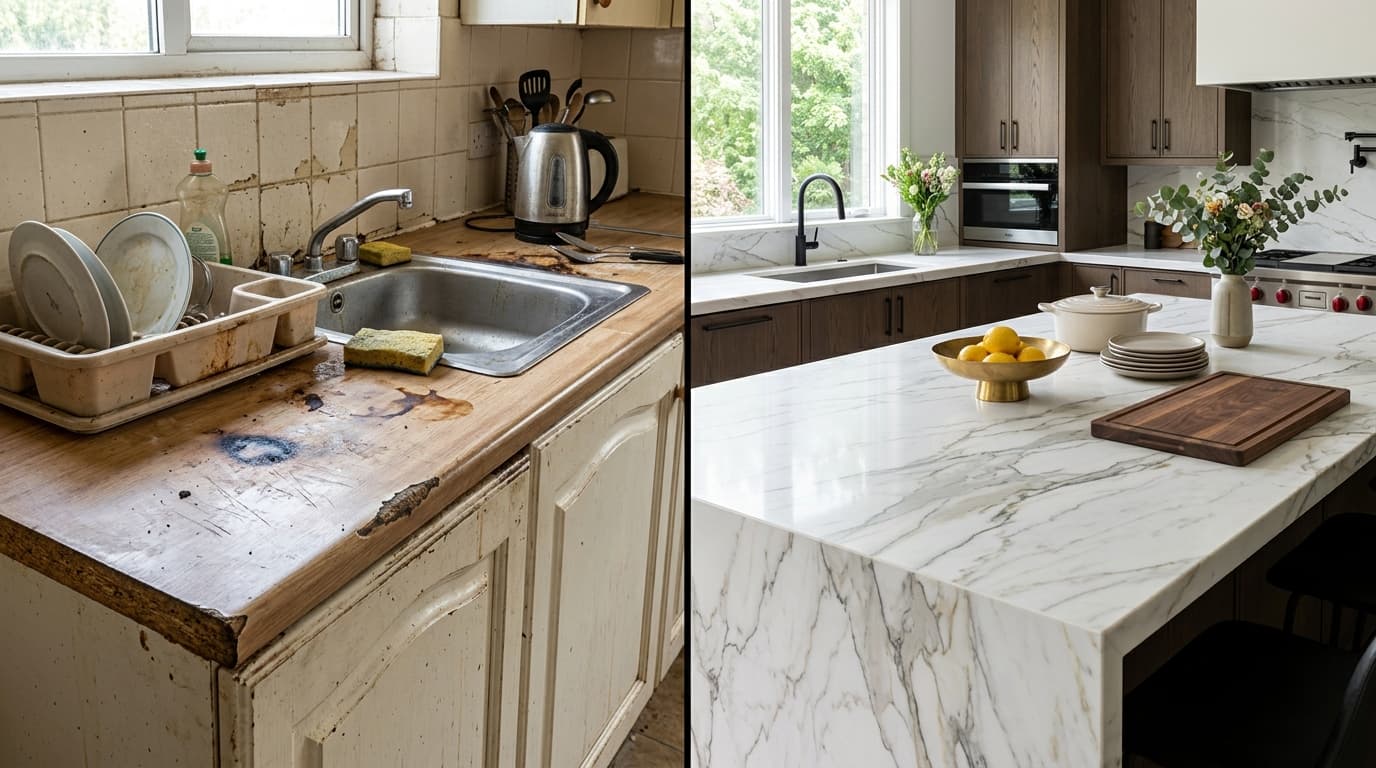
| Performance Attribute | Natural Quartzite | Engineered Quartz Composite | Natural Granite |
|---|---|---|---|
| Mohs Mineral Hardness | 7.0 (Harder than Knife Steel) | 6.5 – 7.0 (Quartz aggregate) | 6.0 – 6.5 (Feldspar/Quartz) |
| Thermal Resistance Limit | 1,000°F+ (Volcanic heat safe) | 300°F Max (Resin scorches) | 600°F (High heat tolerance) |
| Acid Etch Resistance | 100% Acid-Inert (No calcite) | 100% Acid-Inert | 100% Acid-Inert |
| UV Solar Stability | 100% UV-Immune (Indoor/Outdoor) | Fades & Yellows (Indoor only) | 100% UV-Immune (Indoor/Outdoor) |
| Periodic Sealing Required | Yes (Every 2 to 5 years) | Never Required | Yes (Every 1 to 3 years) |
| Installed Cost Range | $190 – $340 per sq. ft. | $100 – $150 per sq. ft. | $75 – $120 per sq. ft. |
Executive Architectural & Engineering Overview: The Kitchen Countertop Triad
In high-performance residential design, horizontal work surfaces endure the most punishing convergence of environmental stressors in the home. Every day, kitchen countertops are subjected to severe mechanical point loading, rapid thermodynamic shock from 450°F cookware, concentrated organic acids (acetic, citric, and lactic), dynamic abrasion from ceramic dishware, and intense ultraviolet (UV) radiation from high-performance architectural glazing. Selecting the appropriate countertop slab material is not merely a stylistic choice; it is a critical specification of material physics and mineral longevity.
Among premium materials, three surfaces dominate the contemporary luxury market: Natural Quartzite, Engineered Quartz (Engineered Composite Stone), and Natural Granite. While marketing materials frequently conflate these materials or present them as interchangeable, their atomic structures, binder chemistries, and thermal limitations could not be more distinct:
- Natural Quartzite: A non-foliated metamorphic rock formed when pure quartz sandstone is subjected to intense subterranean heat (800°C to 1,000°C) and tectonic pressure (exceeding 10,000 atmospheres), fusing quartz sand grains into an interlocking mosaic of crystalline silica.
- Engineered Quartz: A man-made composite material manufactured through the patented Bretonstone process, combining 88% to 93% crushed mineral quartz and granite aggregate with 7% to 12% polyester resin binders, chemical coupling agents, and color pigments.
- Natural Granite: A coarse-grained plutonic igneous rock formed by the slow crystallization of felsic magma beneath the Earth's surface, composed primarily of crystalline quartz, potassium feldspar, plagioclase, and mica minerals.
Understanding how these three distinct material systems perform across multi-decade service lifecycles allows architects and custom home builders to prevent premature surface degradation, thermal cracking, and irreversible chemical etching.
A luxury countertop specification is an engineering equation balancing crystal hardness, binder chemistry, and thermal coefficient of expansion. Confusing natural quartzite with engineered composite resin guarantees aesthetic failure under real-world culinary conditions.
Over a 30-year lifecycle, natural stone surfaces offer superior permanence and restoration capability compared to resin-bound composites. While engineered quartz provides remarkable stain resistance in low-heat interior environments, its polymer resin matrix makes it vulnerable to heat scorching and UV photodegradation. Conversely, natural quartzite and granite can be repeatedly honed, polished, and resealed in situ, outlasting the cabinetry upon which they rest.
---
Geological Mineralogy & Chemical Composition: The Physics of Hardness
The mechanical durability of any stone surface is fundamentally determined by its mineral composition and crystal interlocking.
The Mohs Hardness Hierarchy
The Mohs scale measures mineral scratch resistance by evaluating the ability of a harder substance to scratch a softer one:
- Calcite (Marble/Limestone): Mohs 3. Easily scratched by a common copper penny (Mohs 3.5) or a standard stainless steel kitchen knife (Mohs 5.5).
- Potassium Feldspar (Primary constituent of Granite): Mohs 6. Resists standard cutlery but can be abraded by hardened tool steel or ceramic abrasive compounds.
- Crystalline Quartz (Constituent of Quartzite and Engineered Quartz): Mohs 7. Substantially harder than common high-carbon chef knife blades (Mohs 5.5 to 6.0). Crystalline quartz easily scratches glass (Mohs 5.5) and hardened steel.
- Topaz / Corundum / Diamond: Mohs 8 to 10. Only industrial diamond cutting blades or specialized silicon carbide abrasives can abrade pure crystalline quartzite.
Natural Quartzite: Metamorphic Recrystallization
True natural quartzite (e.g., Taj Mahal, Sea Pearl, White Macaubas, Cristallo) originated millions of years ago as quartz-rich beach sands or desert dunes. During tectonic subduction, regional metamorphism drove temperatures high enough to recrystallize individual sandstone grains. In geology, this process is known as interlocking granoblastic texture: the individual sand grains lose their boundaries and fuse into a solid, monolithic crystal lattice.
- Chemical Formula: Pure Silicon Dioxide ($$\text{SiO}_2$$), typically 90% to 98% pure.
- Optical Depth & Translucency: Because pure quartz crystals are naturally clear, light penetrates deep into the stone slab before refracting outward, giving quartzite an extraordinary visual depth and optical luminosity that opaque composite materials cannot match.
Engineered Quartz: The Bretonstone Polymer Matrix
Engineered quartz (manufactured by brands such as Cambria, Silestone, and Caesarstone) is an engineered polymer-matrix composite:
- Aggregate Matrix: Crushed quartz grains, recycled mirrors, silica sand, and granite fines constitute approximately 90% of the material by weight, but up to 25% by volume.
- Resin Binder: The binding agent is an unsaturated polyester polymer resin cross-linked with styrene monomers.
- Vulnerability: While quartz crystals provide high surface hardness, the polyester resin matrix is an organic polymer with a low glass transition temperature ($$T_g$$). When subjected to temperatures exceeding 300°F (150°C), this resin matrix experiences thermal oxidation, causing irreversible scorch rings, blistering, and micro-cracking.
Natural Granite: Igneous Interlocking
Granite crystallizes slowly deep within continental crustal magma chambers:
- Mineral Breakdown: Typically 25% to 40% Quartz ($$\text{SiO}_2$$), 35% to 50% Alkali and Plagioclase Feldspars ($$\text{KAlSi}_3\text{O}_8$$), and 5% to 15% Biotite Mica and Hornblende.
- Thermal Stability: Because granite formed from molten rock at temperatures exceeding 1,200°F (650°C), its minerals are thermodynamically stable against residential culinary heat. However, the presence of cleavage planes in feldspar and soft mica flakes makes granite slightly more susceptible to micro-chipping along edges compared to monolithic quartzite.
---
Porosity, Water Absorption & Chemical Etching Science
A primary performance benchmark for any architectural food-prep surface is its resistance to liquid absorption and chemical dissolution.
ASTM C97 Water Absorption Benchmarks
Under American Society for Testing and Materials (ASTM C97) standards, stone porosity is measured by drying specimens to constant weight, immersing them in water for 48 hours, and measuring the percentage of weight gain:
| Stone Classification | ASTM C97 Absorption Rate | Porosity Character | Chemical Etch Vulnerability | |---|---|---|---| | Engineered Quartz | < 0.05% by weight | Practically Non-Porous | Zero acid etching; vulnerable to high-pH solvents (acetone, bleach). | | High-Density Quartzite | 0.10% – 0.35% by weight | Extremely Low Porosity | Zero acid etching; chemically inert to vinegar, citrus, and wine. | | Standard Granite | 0.20% – 0.60% by weight | Low to Moderate Porosity | Zero acid etching; vulnerable to oil and pigment absorption if unsealed. | | Calcite Marble | 0.50% – 2.00% by weight | High Porosity | Severe immediate acid etching; reacts instantly with acids ($$\text{CaCO}_3$$). |
Acid Etching vs. Pigment Staining
It is critical to distinguish between staining (the physical absorption of colored pigments into porous micro-channels) and etching (the chemical destruction of stone minerals):
- Acid Etching (Chemical Reaction): Etching occurs when an acidic substance dissolves calcium carbonate minerals:
$$\text{CaCO}_3 + 2\text{H}^+ \rightarrow \text{Ca}^{2+} + \text{H}_2\text{O} + \text{CO}_2$$ True quartzite and granite contain zero calcium carbonate; they consist entirely of silica and silicates, which do not react with acetic acid (vinegar) or citric acid (lemon juice). *Crucial Market Warning*: Many quarry operations and wholesalers mislabel soft dolomitic marbles (such as Super White, Fantasy Brown, or Shadow Storm) as "soft quartzite." In geology, there is no such thing as "soft quartzite." If a slab reacts with acid, it is a marble or dolomite, not a quartzite.
- Pigment Staining (Physical Absorption): Natural stone contains microscopic capillary pores. If wine, cooking oil, or turmeric is left standing on an unsealed quartzite or granite surface, the liquids are drawn inward via capillary forces. In contrast, engineered quartz utilizes an impermeable resin matrix that prevents capillary absorption entirely, eliminating the need for periodic penetrating sealers.
---
Thermal Shock Resistance & Thermodynamic Limits
Thermal performance represents the single most dramatic divergence between natural stone and engineered quartz composites.
The Physics of Thermal Shock
When a boiling-hot pan (350°F to 500°F) is removed from a range and set directly onto a room-temperature (70°F) countertop:
- The top surface immediately underneath the pan rapidly expands according to its Coefficient of Thermal Expansion (CTE).
- The cooler stone directly adjacent and beneath that contact patch resists this expansion, generating immense internal shear and tensile stresses.
- If the material lacks sufficient tensile strength or thermal stability, this stress causes immediate brittle catastrophic fracture, known as thermal shock cracking.
Material Behavior Under Heat:
- Natural Quartzite: Withstands temperatures up to 1,000°F without scorching or structural damage. Homeowners can place roasting pans directly onto quartzite without trivets, though using heat pads is always recommended as best practice to prevent thermal expansion fatigue over decades.
- Natural Granite: Handles direct temperatures up to 600°F safely. Its thermal conductivity dissipates heat quickly, though rapid localized cooling (such as spilling ice water directly onto a hot spot) can occasionally induce cleavage cracks in high-mica stones.
- Engineered Quartz (Strict Heat Limit: 300°F / 150°C): The polyester resin binder melts and degrades above 300°F. Placing a hot Dutch oven, crockpot, or electric skillet directly on engineered quartz causes permanent resin combustion:
- - The resin darkens into an irreversible yellowish-brown ring.
- - The surface gloss burns off, leaving a rough, dull texture.
- - In severe cases, the differential expansion between the expanding quartz particles and the melting resin causes a sudden, loud pop, cracking the slab straight through its entire 3cm thickness.
- - *Manufacturer Warranty Reality*: Every engineered quartz manufacturer explicitly excludes heat damage from their warranty coverage.
+-------------------------------------------------------------------------+
|                  THERMODYNAMIC HEAT RESISTANCE CEILINGS                 |
+-------------------------------------------------------------------------+
  NATURAL QUARTZITE:   1,000°F+ [Extremely Heat Resistant / Volcanic Heat]
  NATURAL GRANITE:       600°F  [Safe for Hot Cookware / Rapid Dissipation]
  ENGINEERED QUARTZ:     300°F  [CRITICAL CEILING: Resin Burns & Scorches]
+-------------------------------------------------------------------------+
---
Ultraviolet (UV) Stability: Interior vs. Outdoor Living Environments
In contemporary luxury architecture, spatial boundaries between interior living areas and exterior outdoor entertainment kitchens are increasingly blurred through expansive sliding glass pocket doors. Specifying the correct stone surface in sun-drenched environments requires evaluating ultraviolet photodegradation.
Polymer Photolysis in Engineered Quartz
The polyester resins utilized in engineered quartz are organic polymers with unsaturated carbon-carbon chemical bonds:
- When exposed to solar ultraviolet radiation (UV-A and UV-B wavelengths between 290nm and 400nm), these polymer chains undergo photolytic degradation.
- Solar UV photons sever the molecular polymer bonds, causing rapid photochemical yellowing, surface cloudiness, and chalking.
- Dark engineered quartz slabs (black, charcoal, navy) will fade to an uneven dull gray within 6 to 12 months if exposed to direct sunlight through skylights, floor-to-ceiling un-tinted glass walls, or in outdoor covered kitchens.
- *Exterior Use Prohibition*: Engineered quartz is strictly prohibited for exterior installations by all major manufacturers.
Natural Stone UV Immunity
Because natural quartzite and granite are 100% inorganic mineral crystals formed within the Earth's crust:
- They are completely immune to ultraviolet degradation.
- Natural quartzite will never fade, yellow, or lose its crystalline luster, regardless of decades of continuous direct solar exposure.
- Quartzite and dense granite are the premier, architecturally endorsed surfaces for outdoor kitchens, patio bar counters, and sun-drenched interior solariums.
---
Fabrication Science: Tooling, Waterjet Speeds & Internal Slab Tension
Fabricating natural quartzite requires commercial-grade CNC machinery, continuous diamond tooling, and immense technical expertise compared to engineered quartz or granite.
Internal Geological Tension in Exotic Quartzite
Because natural quartzite was subjected to immense tectonic forces during formation, massive internal geological stresses remain trapped within the rock:
- When a bridge saw begins cutting into a raw 3cm quartzite slab, this trapped tension can suddenly release, causing the entire $6,000 slab to crack and shatter violently on the fabrication table.
- Tension Relief Cutting Protocol: Master fabricators must program waterjet cutters and CNC saws to perform continuous relief plunge cuts along the perimeter of the slab to relieve internal tectonic stresses before making primary cutout cuts.
Cutting Speeds & Diamond Tooling Wear
- Cutting Speed Comparison: While standard engineered quartz can be cut with bridge saws traveling at 60 to 90 inches per minute, true crystalline quartzite must be cut at ultra-slow feeds of 18 to 28 inches per minute under thousands of gallons of continuous high-pressure cooling water.
- Diamond Blade Consumption: Cutting a single luxury kitchen in exotic quartzite (such as Cristallo or Sea Pearl) can consume an entire $600 diamond saw blade, as the Mohs 7 quartz crystals rapidly strip the diamond matrix off the blade hub. These tooling costs are directly passed on to the consumer in premium fabrication pricing.
Mitered Waterfall Edge Engineering
In luxury kitchen islands, clients demand 2-inch to 3-inch thick laminated mitered waterfall drops, where the horizontal countertop surface cascades down the vertical cabinet face to the floor:
- The fabricator cuts 45-degree bevels along the slab edges using precision 5-axis CNC bridge saws.
- Vein Alignment: The stone templator must digitally bookmatch the natural veins so that the visual grain flows continuously around the 90-degree corner without interruption.
- Structural Epoxy Bonding: The mitered seam is bonded using UV-stable, two-part methacrylate or epoxy adhesive colored with microscopic pigment paste to match the stone's background color, clamped with pneumatic pressure, and polished flush by hand.
---
Granular Itemized Cost Schedule & Fabrication Economics
The financial investment in countertop surfaces divides into raw slab material acquisition, specialized 3D digital templating, high-precision fabrication, and site rigging/installation.
Comprehensive 2026 Cost Comparison (65 Square Foot Kitchen Scope)
| Cost Component / Metric | Engineered Quartz (Cambria/Silestone) | Exotic Natural Quartzite (Taj Mahal) | Premium Natural Granite (Black Galaxy) | |---|---|---|---| | Raw Slab Material (per Sq. Ft.) | $45 – $75 | $95 – $175 | $35 – $65 | | Fabrication & Cutout Labor | $30 – $45 | $55 – $85 | $25 – $40 | | Mitered Waterfall Edge Drops | $45 – $65 / linear ft | $85 – $140 / linear ft | $40 – $60 / linear ft | | Total Slabs Required (Standard Kitchen) | 2 Slabs ($3,200 – $5,000) | 2 Slabs ($6,500 – $11,500) | 2 Slabs ($2,400 – $4,200) | | Total Installed Cost (65 Sq. Ft.) | $6,500 – $9,800 | $12,500 – $22,000 | $4,800 – $7,800 | | Average Cost per Square Foot Installed | $100 – $150 / sq. ft. | $190 – $340 / sq. ft. | $75 – $120 / sq. ft. |
Key Economic Drivers of the Quartzite Premium
The 100% to 150% price premium of exotic natural quartzite over engineered quartz is driven by three inescapable market realities:
- Quarrying Yields & Geographic Rarity: The finest crystalline quartzites are extracted from deep mountain quarries in Minas Gerais and Espirito Santo, Brazil. Because quartzite is so hard, extracting whole, un-fractured 10-foot by 6-foot slabs without explosives is extraordinarily labor-intensive. Quarry yield rates of defect-free luxury slabs are under 30%.
- Maritime Freight Weight: Dense 3cm quartzite weighs approximately 20 lbs per square foot. Shipping multi-ton crates across oceans commands high international freight surcharges.
- Fabricator Breakage Risk Insurance: Fabricators build a 15% to 20% risk premium into their labor pricing to insure against the potential of a slab cracking during CNC waterjet profiling or transport into high-rise luxury buildings.
---
Step-by-Step Installation & Maintenance Protocol
Ensuring that a luxury stone installation survives decades without joint failure requires strict chronological execution.
Phase 1: Cabinet Substrate Inspection & Laser Planarity
- Verify that base cabinets are leveled to within 1/16 inch across a 10-foot span using a rotary laser level. Stone has zero tensile flexibility; setting a rigid slab on an uneven cabinet run induces continuous bending tension that will eventually snap the stone along a vein.
- Install 1/2-inch structural steel cantilever support brackets every 24 inches for any stone overhang extending beyond 10 inches.
Phase 2: 3D Digital Metrology & Slab Nesting
- Following base cabinet anchoring, a digital templating technician uses a Proliner laser tracker to map all walls, drywall out-of-square conditions, sink cutouts, and faucet hole centerlines down to 0.5mm precision.
- The client reviews a digital CAD nesting mockup showing exactly how the stone's veining patterns will traverse seams, cooktop cutouts, and waterfall drops before any cutting begins.
Phase 3: Setting, Seaming & Chemical Anchoring
- Heavy slabs are brought into the home using specialized hydraulic A-frame carts and vacuum suction lifters.
- Slabs are dry-fitted onto cabinets to confirm perimeter reveals and joint gap tolerances (joint gap should not exceed 1/16 inch).
- Seams are joined using two-part polyester knife-grade resin tinted with color pigments. Pneumatic vacuum seam-setters clamp the slabs together with thousands of pounds of horizontal pull force while leveling screws pull the surface perfectly flush.
- Excess epoxy is razor-planed flush once cured to a rubbery state, leaving a nearly invisible hairline seam.
Phase 4: Penetrating Impregnator Sealing (Natural Stone Only)
- Natural quartzite and granite must be thoroughly deep-cleaned with denatured alcohol to remove surface oils and dust.
- Apply a premium, solvent-based fluoropolymer penetrating impregnator (such as Tenax Proseal, Dry-Treat Stain-Proof, or Miracle 511 Porous Plus).
- The microscopic fluoropolymer molecules penetrate into the sub-surface capillary pores of the stone, cross-linking within the crystalline lattice. This creates a hydrophobic and oleophobic barrier that repels water, wine, and grease without altering the stone's natural breathability or optical appearance.
- Allow sealer to dwell for 15 minutes, then vigorously buff the surface dry with microfiber towels to eliminate surface haze.
---
Forensic Failure Analysis: Five Critical Stone Countertop Defects
Forensic inspection of failed luxury stone installations reveals predictable patterns of chemical, thermal, and mechanical neglect.
1. The Acid Etch Disappointment (False Quartzite)
- Physical Manifestation: Dull, cloudy white rings and patches appearing wherever lemon slices, vinegar, or wine rested on a newly installed polished quartzite counter.
- Root Forensic Cause: Wholesaler or retailer selling a dolomitic marble (e.g., Super White) under the deceptive label of "Soft Quartzite." The calcium carbonate minerals reacted instantly with acids, destroying the polished surface finish.
- Mandatory Preventative Engineering: Always perform the Glass Scratch and Acid Test on a rough corner of the slab at the stone yard prior to purchase. True quartzite will slice deep grooves into glass bottles with zero effort and will not bubble or fizz when concentrated lemon juice or muriatic acid is applied.
2. Quartz Resin Scorch Rings
- Physical Manifestation: An unrepairable dark yellowish-brown ring burned into the countertop around the base of a slow cooker, instant pot, or hot frying pan on engineered quartz.
- Root Forensic Cause: Thermodynamic oxidation and thermal breakdown of the organic polyester resin binder when exposed to temperatures exceeding 300°F.
- Mandatory Preventative Engineering: Educate homeowners that engineered quartz is not heat-proof. High-heat culinary appliances must always sit on silicone trivets or heavy hardwood cutting boards.
3. Tension Stress Fractures at Cooktop Corners
- Physical Manifestation: Hairline cracks starting at the inside corner of a drop-in cooktop cutout and propagating diagonally toward the front edge of the countertop.
- Root Forensic Cause: Fabricator cutting the rectangular cooktop cutout with sharp 90-degree square inside corners using a standard bridge saw, creating severe internal mechanical stress risers. Combined with thermal expansion from the cooktop, the stone cracks under tension.
- Mandatory Preventative Engineering: Mandate that all inside cutouts feature a minimum 3/8-inch (10mm) to 1/2-inch (12mm) radius curved inside fillet cut via waterjet or core drill, distributing mechanical and thermal stress uniformly.
4. Adhesive Seam Yellowing and Separation
- Physical Manifestation: Countertop seams widening, turning dirty dark yellow, and accumulating grease within 2 to 3 years.
- Root Forensic Cause: Fabricators using cheap, uncatalyzed polyester filler adhesive exposed to ambient ultraviolet light, combined with subfloor movement flexing the joint.
- Mandatory Preventative Engineering: Require UV-stable, non-yellowing two-component methacrylate or pure epoxy adhesives, combined with mechanical biscuit/shim support beneath the joint.
5. Perimeter Edge Chipping
- Physical Manifestation: Small jagged chips breaking off the top perimeter edge of the countertop around the undermount sink basin from heavy pots and pans.
- Root Forensic Cause: Specifying a sharp, square pencil edge or micro-bevel profile on fragile stone.
- Mandatory Preventative Engineering: Specify a minimum 1/4-inch to 3/8-inch rounded bullnose, demi-bullnose, or large-radius eased edge around heavy impact zones like the sink cutout to deflect direct impact energy.
---
Real-World Architectural Case Studies
Case Study 1: The Sun-Drenched Desert Estate — Scottsdale, Arizona
- Architectural Scope: Complete indoor-outdoor kitchen installation with 140 square feet of continuous countertop running through an expansive 20-foot automated pocketing glass wall system.
- Engineering Dilemma: The client originally specified pure white engineered quartz for both the interior island and the exterior poolside grill station. The architect warned that Scottsdale's extreme UV index (11+) and ambient summer temperatures (115°F) would destroy the engineered quartz outdoors.
- Applied Solutions:
- *Material Transition*: The specification was upgraded to 3cm natural Taj Mahal Quartzite with a honed (satin) finish across both the interior and exterior runs.
- *UV & Heat Immunity*: The natural quartzite remained completely immune to the blistering Arizona sun, with zero fading or resin degradation.
- *Sealing*: Applied Dry-Treat Stain-Proof deep impregnating sealer, repelling barbecue grease and red wine while allowing the stone to breathe naturally.
- Financial Tally: Material & Fabrication: $26,400 (3 slabs Taj Mahal Quartzite); Installation & Mitered Edges: $7,800; Total Cost: $34,200.
Case Study 2: The Urban Culinary Penthouse — Chicago, Illinois
- Architectural Scope: High-intensity culinary kitchen for an avid home chef, featuring a 48-inch commercial gas range, sous-vide stations, and an expansive 12-foot by 5-foot central entertaining island.
- Engineering Dilemma: The homeowner desired the luminous, dramatic veining of Italian Calacatta marble but refused to accept acid etching, wine staining, or heat trivets.
- Applied Solutions:
- *Material Specification*: Installed 3cm natural Cristallo Quartzite with translucent crystalline windows.
- *Backlit Engineering*: Integrated LED light diffusion sheets beneath the island overhang, illuminating the crystalline quartzite structure at night with 2700K warm architectural light.
- *Stress Protection*: Fabricated all cutouts with 1/2-inch radius inside corners and embedded flush 1/2-inch structural steel bars routed beneath the island stone overhang.
- Financial Tally: Material & Fabrication: $38,500 (2 bookmatched Cristallo slabs); Backlighting Integration & Steel Framing: $6,200; Total Cost: $44,700.
---
Architectural Specification Guide: Master Division Standards
When specifying countertops for luxury residential projects, architects adhere to MasterFormat Division 12:
Division 12 36 40 — Stone Countertops
- Stone Classification: Natural Quartzite conforming to ASTM C616 (Standard Specification for Quartz-Based Dimension Stone, Grade I Quartzite). Minimum quartz content: 90% crystalline $$\text{SiO}_2$$.
- Hardness: Mohs mineral hardness rating minimum 7.0 verified by scratch testing.
- Absorption: Maximum water absorption rate 0.35% by weight per ASTM C97.
- Flexural Strength: Minimum flexural strength 2,000 psi per ASTM C880.
- Sealer: Fluorochemical solvent-based penetrating impregnator conforming to FDA food-contact safety standards.
Division 12 36 61 — Solid Surfacing & Quartz Composites
- Composition: Minimum 88% crushed natural quartz by weight, maximum 12% polyester resin and pigments.
- Hardness: Barcol hardness minimum 85 per ASTM D2583.
- Heat Resistance: Limit continuous exposure below 300°F (150°C). Manufacturer warranty must document resin degradation thresholds.
---
General Contractor & Fabricator Vetting Guide
To ensure that thousands of dollars of exotic stone slabs are not ruined during fabrication and installation, apply strict vetting benchmarks:
The Fabricator Vetting Checklist
- Natural Stone Institute (NSI) Accredited Fabricator: Verify that the stone fabrication facility is accredited by the Natural Stone Institute. Accredited fabricators have passed comprehensive audits testing CNC waterjet metrology, jobsite safety, and trade knowledge.
- Digital Slab Layout Approval: Require that the fabricator provide a high-resolution digital photograph of your exact slabs with a digital CAD overlay (Slabsmith software or equivalent) showing exactly where veins intersect, where seams are located, and how mitered edges will waterfall before any cuts are made.
- Written Seam Warranty: Ensure the contract guarantees that stone seams will not exceed 1/16 inch in width, will be color-matched to the stone field color, and will remain structurally sound and level.
---
Frequently Asked Questions (Technical & Financial)
1. How can I test a stone slab in the yard to confirm it is true quartzite and not marble?
Perform the two-step Glass Scratch and Acid Test. Bring an empty glass bottle (such as a Snapple bottle) and a small dropper bottle of muriatic acid or concentrated lemon juice to the stone yard. Find a rough, unpolished corner on the actual slab you are purchasing. First, press the sharp edge of the stone firmly against the glass bottle; true quartzite (Mohs 7) will slice easily through glass (Mohs 5.5) like a diamond blade, whereas marble (Mohs 3) will slide off or crush into white powder without scratching the glass. Second, place three drops of acid on the stone surface and wait 5 minutes; if the liquid fizzes, bubbles, or leaves a dull chalky mark, the stone contains calcite and is a marble, not a quartzite.
2. Can I set hot pans directly onto natural quartzite without damaging it?
Yes. Natural quartzite is a metamorphic rock formed under volcanic temperatures exceeding 1,000°F, meaning standard household cookware (even cast-iron skillets taken straight from a 500°F oven) will not scorch, melt, or burn the stone. In contrast, engineered quartz contains plastic polyester resins that permanently burn and turn yellow above 300°F. However, while quartzite will not burn, using trivets or hot pads is still recommended by the Natural Stone Institute as best practice to eliminate thermal expansion fatigue over decades of use.
3. Does natural quartzite require regular sealing?
Yes. While quartzite is substantially denser than marble and granite, it is still a natural stone containing microscopic capillary pores. Applying a premium fluorochemical penetrating impregnating sealer (such as Dry-Treat Stain-Proof or Tenax Proseal) once every 2 to 5 years takes approximately 30 minutes: wipe the liquid on with a cloth, let it dwell for 15 minutes to penetrate into the crystalline lattice, and buff dry. A properly sealed quartzite counter will cause water, wine, and oil to bead up on the surface indefinitely.
4. Why is engineered quartz prohibited for outdoor kitchens?
Engineered quartz uses polyester resin as its binding matrix. When exposed to solar ultraviolet (UV) radiation outdoors, the resin undergoes photochemical decomposition (polymer photolysis), causing dark colors to fade to dull chalky gray and white slabs to turn an unsightly yellowish-tan. Natural quartzite and granite are 100% inorganic minerals that are completely immune to UV radiation and can withstand decades of direct desert sunlight without fading or degrading.
5. Why do fabricators charge so much more to cut quartzite than granite or quartz?
Because crystalline quartz has a Mohs hardness of 7, it is exceptionally abrasive on fabrication equipment. A CNC waterjet or bridge saw must cut quartzite at speeds between 18 and 28 inches per minute (compared to 70+ inches per minute for engineered quartz), consuming massive amounts of electricity and water. Furthermore, cutting a single kitchen in quartzite can completely wear out a $600 diamond saw blade, and fabricators must manage the risk of raw slabs cracking on the cutting table due to internal geological tension trapped during tectonic formation.
6. Can chipped edges on quartzite and engineered quartz be repaired invisibly?
Yes, minor chips along countertop edges or sink cutouts can be repaired by a professional stone restoration technician. The technician fills the void with a two-part UV-curing acrylic or clear knife-grade epoxy tinted with colored stone dust to match the natural mineral grain. Once cured, the resin is hand-honed and polished flush with diamond abrasive pads. While the repair is virtually invisible from standing height, natural stone repairs look more natural than composite repairs because the resin blends seamlessly into the organic mineral crystals.
7. What is the maximum unsupported overhang allowed for natural stone countertops?
Under Natural Stone Institute (NSI) guidelines, a 3cm (1-1/4 inch) thick natural quartzite or granite slab can cantilever up to 10 inches unsupported, provided that at least two-thirds of the total slab width remains supported by the base cabinets. Any overhang exceeding 10 inches—such as a 12-inch or 16-inch breakfast bar or island seating overhang—strictly requires structural concealed 1/2-inch structural steel or aluminum support brackets fastened securely to the cabinet framing every 24 inches on center.
Frequently Asked Questions
Written by Julian Vance
Senior Architectural Designer & Principal EditorJulian holds a Master of Architecture (M.Arch) and brings over 14 years of experience specializing in luxury residential additions, historic preservation, and bespoke cabinetry ergonomics. He oversees architectural integrity and design analysis at Estatique.
Related Research in Kitchen & Bath
2026 Luxury Kitchen Remodeling Cost Guide: Custom Cabinetry, Exotic Stone & Layout Ergonomics
Detailed financial and architectural breakdown for luxury kitchen renovations: inset custom cabinets, quartzite slab costs, MEP relocation, and designer fees.
Curbless Walk-In Shower Engineering: Waterproofing Systems, Linear Drains & Slope Ratios
Architectural blueprints for zero-threshold barrier-free showers: subfloor recessing, uncoupling waterproofing membranes, linear drain placement, and large format tile.
Master Bathroom Spa Architecture: Wet Room Layouts, Ergonomics & Plumbing Clearances
Design blueprint for master bath spa suites: European wet rooms, freestanding tub integration, dual vanity ergonomics, and acoustic wall decoupling.