Indoor Air Quality (IAQ) Masterclass: MERV 16, True HEPA & Energy Recovery Ventilation
Eliminate PM2.5, wildfire smoke, and VOCs: whole-home HEPA bypass filtration, deep 5-inch MERV 16 media, ERVs vs HRVs, and active relative humidity control.

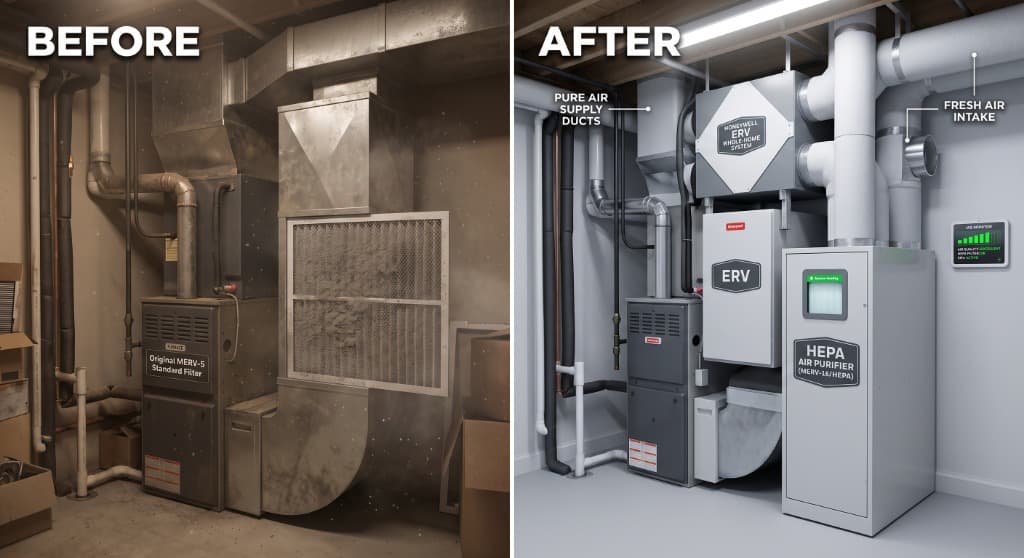
| Purification Technology | Target Contaminant Class | Capture / Exchange Efficiency | Static Pressure Impact | Maintenance Schedule |
|---|---|---|---|---|
| 1-Inch Retail Filter (MERV 8-11) | Large dust & lint only | <20% capture of PM2.5 | High restriction (0.35+ in. w.g.) | Replace every 30 – 60 Days |
| 5-Inch Deep-Pleat MERV 16 | Smoke, bacteria, allergens, PM2.5 | ≥95% capture down to 0.3 µm | Ultra-Low (0.12 in. w.g. across pleats) | Replace every 9 – 12 Months |
| Bypass True Medical HEPA | Ultrafine particles, viruses, soot | 99.97% capture of 0.3 µm (DOE) | Zero impact on main HVAC blower | Replace every 2 – 3 Years |
| Sorbent Carbon / KMnO4 Bed | VOCs, formaldehyde, chemical odors | Chemical chemisorption / Van der Waals | Dedicated bypass fan operated | Replace every 12 – 24 Months |
| Enthalpy ERV Fresh Air System | High CO2, indoor dampness, stale air | Recovers 80%+ heat & moisture (SRE) | Independent dedicated ducting | Clean core & filters every 6 mos |
Executive Architectural & Engineering Overview: The Airtight Envelope Dilemma
In contemporary high-performance residential architecture, building envelopes are sealed with unprecedented precision. Driven by stringent energy conservation codes (IECC) and sustainable standards like Passive House (PHIUS) and LEED for Homes, modern residences achieve airtightness ratings below 1.0 to 1.5 Air Changes per Hour at 50 Pascals (ACH50). These ultra-tight envelopes virtually eliminate uncontrolled air infiltration, drastically lowering heating and cooling energy consumption and banishing uncomfortable winter drafts.
However, an airtight building envelope creates a critical, unintended health consequence: The Indoor Air Quality (IAQ) Paradox. When a home is sealed like a thermos, it traps all indoor contaminants generated by occupants, building materials, and daily living activities. Without an engineered mechanical ventilation and air purification strategy, indoor air becomes two to five times more polluted than outdoor city air, according to the U.S. Environmental Protection Agency (EPA).
In luxury estate design, discerning homeowners now recognize that pristine air quality is the ultimate foundation of health, restorative sleep, and cognitive performance. Engineering a whole-home architectural air purification ecosystem requires coordinating four interdependent technical layers:
- Deep-Pleat High-Efficiency Filtration (MERV 13 to MERV 16): Capturing microscopic airborne particles, pollen, pet dander, and wild-fire smoke without choking the HVAC system's static pressure.
- Bypass True Medical-Grade HEPA Filtration: Certified under DOE-STD-3020 to capture 99.97% of all particles down to 0.3 microns (including bacteria, mold spores, and combustion ultrafine particles).
- Balanced Enthalpy Energy Recovery Ventilation (ERV): Providing continuous, controlled fresh outdoor air while recovering up to 75% to 85% of the thermal energy and humidity from the outgoing exhaust airstream under ASHRAE Standard 62.2.
- Gas-Phase Sorbent Adsorption (Activated Carbon & Potassium Permanganate): Chemically neutralizing volatile organic compounds (VOCs), formaldehyde off-gassed by custom millwork, and urban chemical odors.
- In-Duct Ultraviolet Germicidal Irradiation (UV-C): Destroying bio-aerosols and preventing microbial mold biofilm from colonizing wet evaporator coils.
True luxury in residential design is invisible. It is walking into an estate where the air feels as crisp and invigorating as an alpine meadow, where sleep is deep and undisturbed, and where carbon dioxide levels never induce afternoon cognitive fatigue.
By examining the aerosol physics of filtration, enthalpy core thermodynamics, and system static pressure balancing, this guide establishes the definitive masterclass for architectural indoor air quality.
---
The Indoor Pollution Landscape: PM2.5, VOCs & Carbon Dioxide Dynamics
To design an effective purification system, mechanical engineers must first categorize the three distinct classes of indoor airborne contaminants.
+-------------------------------------------------------------------------+
|                  THE TRIAD OF INDOOR AIR CONTAMINANTS                   |
+-------------------------------------------------------------------------+
  1. PARTICULATE MATTER (PM10, PM2.5, PM0.1):
     [Dust, Pollen, Dander] ──> [Smoke, Bacteria] ──> [Ultrafine Viruses]
     *Solution: Mechanical Filtration (MERV 16 & True HEPA)*

  2. CHEMICAL GASES & VOCs:
     [Formaldehyde, Paint Solvents, Cooking Odors, Aerosols]
     *Solution: Chemical Sorbent Adsorption (Activated Carbon)*

  3. BIOLOGICAL PATHOGENS & DAMPNESS:
     [Mold Spores, Legionella, Viruses, High CO2 Concentrations]
     *Solution: Balanced ERV Ventilation + Germicidal UV-C Irradiation*
+-------------------------------------------------------------------------+
1. Particulate Matter ($$\text{PM}_{10}$$, $$\text{PM}_{2.5}$$, and Ultrafine Particles)
Airborne particles are classified by their aerodynamic diameter measured in micrometers (microns):
- $$\text{PM}_{10}$$ (10 Microns): Coarse dust, plant pollen, mold spores, and textile fibers. Filtered naturally by the human nose and upper respiratory tract.
- $$\text{PM}_{2.5}$$ (2.5 Microns): Fine combustion smoke, wildfire particulates, pet dander, and bacteria. These microscopic particles bypass the body’s natural defenses, penetrating deep into the alveolar sacs of the lungs and entering the bloodstream, driving systemic vascular inflammation and cardiovascular stress.
- Ultrafine Particles ($$\text{PM}_{0.1}$$ / Sub-Micron): Viruses, cooking grease aerosols, and industrial smog nanoparticles. These represent over 90% of all airborne particles by numeric count.
2. Volatile Organic Compounds (VOCs) & Formaldehyde
Modern luxury interiors are packed with synthetic materials that release chemical vapors through outgassing:
- Custom architectural millwork, plywood subflooring, and engineered stone adhesives emit Formaldehyde ($$\text{CH}_2\text{O}$$)—a known human carcinogen—for up to 3 to 5 years after installation.
- Interior paints, wall coverings, wood floor polyurethanes, and luxury furniture off-gas benzene, toluene, and xylene.
- Standard particulate filters (even HEPA filters) have zero effect on VOCs; chemical gases pass straight through mechanical fibers like water through a fishing net.
3. Carbon Dioxide ($$\text{CO}_2$$) & Cognitive Impairment
In tightly sealed bedrooms without mechanical fresh air exchange, occupant respiration causes carbon dioxide levels to soar overnight:
- Outdoor baseline ambient air contains approximately 420 parts per million (ppm) of $$\text{CO}_2$$.
- In an unventilated master bedroom with two adults and closed doors, indoor $$\text{CO}_2$$ concentrations routinely climb past 1,500 to 2,500 ppm by 4:00 AM.
- Peer-reviewed cognitive studies from the Harvard T.H. Chan School of Public Health prove that human cognitive function, strategic decision-making, and deep REM sleep architecture degrade significantly when ambient $$\text{CO}_2$$ levels exceed 1,000 ppm.
---
Filtration Mechanics: MERV 16 Deep-Pleat vs. Medical-Grade True HEPA
Understanding the engineering distinction between central ducted media filters and dedicated bypass HEPA systems is critical for avoiding catastrophic airflow starvation.
+-------------------------------------------------------------------------+
|                  ASHRAE 52.2 FILTRATION HIERARCHY                       |
+-------------------------------------------------------------------------+
  MERV RATING       E1 (0.3 - 1.0 µm)     E2 (1.0 - 3.0 µm)     E3 (3.0 - 10 µm)
  MERV 8                   < 20%                 < 50%                 ≥ 70%
  MERV 11                  ≥ 20%                 ≥ 65%                 ≥ 85%
  MERV 13                  ≥ 50%                 ≥ 85%                 ≥ 90%
  MERV 16                  ≥ 95%                 ≥ 95%                 ≥ 95%
  TRUE HEPA (DOE)          99.97%                99.99%                100%
+-------------------------------------------------------------------------+
1. The ASHRAE 52.2 MERV Scale Deconstructed
The Minimum Efficiency Reporting Value (MERV) evaluates a filter's ability to capture particles across three distinct size ranges ($$E_1$$, $$E_2$$, and $$E_3$$):
- MERV 8 (Builder Grade): Captures only large dust bunnies and lint. Completely useless against wildfire smoke, fine pollen, bacteria, or viruses ($$E_1 < 20\%$$).
- MERV 13 (LEED Baseline): The minimum standard for high-performance buildings. Captures ≥50% of 0.3–1.0 micron particles and ≥85% of 1.0–3.0 micron particles. Capable of trapping wildfire smoke and large droplet nuclei.
- MERV 16 (Hospital Operating Suite Standard): The gold standard for central ducted residential air handlers (e.g., Lennox Healthy Climate Carbon Clean 16 or Aprilaire 5000). Captures ≥95% of all particles down to 0.3 microns, including fine bacteria, smoke, and smog.
2. Deep-Pleat 4-Inch to 6-Inch Media Engineering
A common amateur error is inserting an ultra-dense, 1-inch thick MERV 13 or MERV 16 filter into a standard residential return grille:
- A 1-inch dense filter creates immense aerodynamic static resistance (often exceeding 0.30 to 0.45 in. w.g. of static pressure drop across the filter alone). This chokes the HVAC blower fan, burns out the motor, freezes the evaporator coil, and cuts airflow in half.
- Architectural specifications strictly mandate Deep-Pleat 4-inch to 6-inch Media Cabinets:
- - The deep accordion pleats expand the total physical surface area of the filter media by 400% to 600% (e.g., over 35 square feet of continuous microfiber surface inside a compact 16x25x5 inch frame).
- - This massive surface area slows down face velocity, allowing deep filtration to capture 95%+ of particles while maintaining a negligible initial static pressure drop of only 10 to 0.15 in. w.g., preserving HVAC blower efficiency.
3. True Medical-Grade HEPA (DOE-STD-3020)
Originally developed during the Manhattan Project to trap radioactive particles, a True HEPA (High-Efficiency Particulate Air) filter must be individually tested and certified to remove at least 99.97% of all airborne particles down to 0.3 microns in diameter:
- *Why 0.3 Microns?* In fluid dynamics, 0.3 microns is the Most Penetrating Particle Size (MPPS). Particles larger than 0.3 microns are easily captured by mechanical inertial impaction and interception; particles smaller than 0.1 microns bounce erratically due to Brownian motion and are trapped by diffusion. The 0.3-micron particle is the hardest to trap.
- Bypass Slipstream Integration: A True HEPA filter is too dense to place directly in the main central HVAC airflow stream (a whole-home blower cannot push 1,200 CFM through a HEPA matrix without massive commercial fan power). Instead, architects install a Bypass HEPA Purification Loop (such as an IQAir Perfect 16 or Amaircare 4000):
- - The bypass unit diverts approximately 20% to 30% of the return air stream (typically 250 to 350 CFM) through a dedicated, sound-insulated centrifugal booster fan.
- - The air passes through a multi-stage pre-filter, a heavy medical HEPA bed, and a sorbent carbon canister, returning hospital-grade sterile air back into the primary supply trunk.
- - Over a 24-hour period, the entire volume of home air is scrubbed through the True HEPA loop between 30 and 50 times.
---
Gas-Phase Chemical Adsorption: Activated Carbon & Potassium Permanganate
Mechanical microfiber filters capture physical particles, but they cannot stop gaseous chemical molecules. Neutralizing odors, ozone, and toxic VOCs requires Chemical Sorbent Adsorption.
The Physics of Activated Carbon Adsorption
Activated carbon is manufactured by processing carbonaceous materials (such as coconut shells or bituminous coal) with high-temperature steam, creating an extraordinary network of sub-microscopic pores:
- Massive Surface Area: Just one single gram of high-grade activated coconut-shell carbon possesses a surface area exceeding 1,000 to 1,500 square meters (a single pound of carbon contains the equivalent surface area of over 100 football fields).
- Van der Waals Adsorption: As gaseous molecules (VOCs, cooking odors, petrochemical fumes) pass through the carbon bed, they are trapped within the microscopic pores by intermolecular Van der Waals attractive forces.
Chemisorption with Potassium Permanganate ($$\text{KMnO}_4$$)
Certain dangerous chemical gases—specifically Formaldehyde, Hydrogen Sulfide, and Ethylene—are too lightweight to be held reliably by standard physical carbon adsorption:
- Premium whole-home chemical canisters utilize a 50/50 blend of virgin activated carbon and activated alumina pellets impregnated with 6% to 8% Potassium Permanganate ($$\text{KMnO}_4$$).
- Potassium permanganate is a powerful oxidizing agent. When formaldehyde gas touches the pellet, it undergoes chemisorption: a permanent chemical reaction that oxidizes toxic formaldehyde into harmless carbon dioxide and water vapor:
$$3\text{CH}_2\text{O} + 4\text{KMnO}_4 \rightarrow 3\text{CO}_2 + 4\text{MnO}_2 + 4\text{KOH} + \text{H}_2\text{O}$$
---
Mechanical Fresh Air Ventilation: ERV vs. HRV Engineering (ASHRAE 62.2)
Filtering recirculated indoor air is essential, but it does nothing to remove accumulated carbon dioxide or replenish oxygen. A high-performance home strictly requires continuous mechanical fresh air exchange.
+-------------------------------------------------------------------------+
|                  ERV vs. HRV THERMODYNAMIC MECHANISM                    |
+-------------------------------------------------------------------------+
  HEAT RECOVERY VENTILATOR (HRV):
  - Sensible Heat Transfer ONLY (Temperature Exchange)
  - Latent Heat (Moisture / Humidity) is REJECTED or DRAINED
  - Best for: Cold, dry northern climates with high winter indoor humidity

  ENERGY RECOVERY VENTILATOR (ERV):
  - Sensible Heat Transfer + Latent Moisture Transfer (Enthalpy Core)
  - Membrane transfers water vapor molecules between airstreams
  - Best for: Year-round humid climates & tightly sealed modern envelopes
+-------------------------------------------------------------------------+
Sizing Continuous Ventilation (ASHRAE Standard 62.2)
Under ASHRAE Standard 62.2 (Ventilation and Acceptable Indoor Air Quality in Residential Buildings), the required continuous whole-house mechanical ventilation rate is calculated as: $$\text{Target CFM} = 0.03 \times \text{Conditioned Floor Area (sq. ft.)} + 7.5 \times (\text{Number of Bedrooms} + 1)$$
- For a 4,500-square-foot luxury residence with 4 bedrooms:
$$\text{Target CFM} = (0.03 \times 4,500) + 7.5 \times (4 + 1) = 135 + 37.5 = 172.5 \text{ CFM}$$
- To maintain pristine air quality and keep $$\text{CO}_2$$ below 800 ppm, the mechanical system must introduce 175 CFM of continuous fresh outdoor air 24 hours a day, 365 days a year.
The Enthalpy Recovery Core (ERV Advantages)
Dumping 175 CFM of raw outdoor air into a home would destroy energy efficiency and overwhelm indoor humidity control:
- In summer (95°F and 80% RH outside), an ERV transfers heat and humidity from the incoming fresh air into the outgoing cool exhaust air, pre-cooling and dehumidifying the fresh air before it enters the home.
- In winter (15°F and 20% RH outside), the ERV transfers heat and moisture from the outgoing stale air into the incoming dry winter air, pre-heating and humidifying the fresh air, preventing dry skin, static electricity, and shrinking hardwood floors.
- Premium ERVs (such as Zehnder ComfoAir Q, Panasonic Intelli-Balance, or RenewAire) achieve Apparent Sensible Effectiveness (SRE) exceeding 80% to 85%, recovering the vast majority of thermal energy while maintaining total physical separation between the fresh and stale airstreams.
---
Ultraviolet Germicidal Irradiation (UV-C) & Microbial Biofilm Elimination
The dampest, darkest environment in a home's mechanical system is the indoor air conditioning evaporator coil and condensate drain pan. During summer cooling, the coil is continuously wet with condensed water vapor, creating an ideal breeding ground for microbial biofilms, mold (*Aspergillus* and *Penicillium*), and bacterial slime.
The 254-Nanometer Germicidal Mechanism
When biological pathogens pass over a wet coil, they colonize the aluminum fins, releasing volatile organic microbial toxins (which cause the foul "dirty sock syndrome" odor) and shedding microscopic spores into the supply ductwork:
- Photolytic DNA Disruption: Installing a commercial-grade In-Duct UV-C Lamp emitting electromagnetic radiation at precisely 253.7 nanometers (the germicidal C-band wavelength) eliminates this threat.
- UV-C photons penetrate the cellular walls of bacteria, viruses, and mold spores, permanently disrupting their DNA and RNA molecular thymine dimers. The microorganisms are rendered sterile and unable to reproduce, killing the biofilm on the coil surface.
- Continuous Coil Disinfection: A properly sized parabolic UV-C fixture (such as Sanuvox or Fresh-Aire UV) running 24/7 across the evaporator coil face keeps the aluminum fins sterile and clean down to bare metal, preserving coil heat transfer efficiency and eliminating biological airborne contamination.
---
Itemized Cost Schedule & Regional Labor Breakdown
Building a comprehensive, medical-grade whole-home air purification and ventilation ecosystem represents an investment in human health and longevity.
Comprehensive 2026 Budget Breakdown ($14,500 Complete System Scope)
| IAQ System Scope / Component | Premium Equipment & Hardware | Master Craft Trade Labor | Total Installed Cost | % of Budget | |---|---|---|---|---| | High-Efficiency Enthalpy ERV (200 CFM) | $3,200 (Zehnder ComfoAir / Panasonic Intelli-Balance) | $1,600 (Mechanics mounting unit, core drilling walls) | $4,800 | 33.1% | | Dedicated Exterior Intake/Exhaust Ducting | $650 (Insulated 6" rigid pipe, exterior wall hoods) | $850 (Sheet metal fabrication & weather flashing) | $1,500 | 10.3% | | Central Ducted MERV 16 Deep-Pleat Media Cabinet | $750 (Lennox Carbon Clean 16 / Aprilaire 5000) | $650 (Custom sheet metal transition plenum fabrication) | $1,400 | 9.7% | | Bypass True Medical HEPA & Carbon Scrubber | $2,400 (IQAir Perfect 16 / Amaircare 4000 bypass) | $1,200 (Electrical homerun, bypass duct connections) | $3,600 | 24.8% | | Coil-Irradiating High-Output UV-C System | $850 (Fresh-Aire UV APCO-X dual-wavelength germicidal) | $450 (Electrical interlock wiring & safety switches) | $1,300 | 9.0% | | Continuous Multi-Gas Air Quality Monitoring Hub | $650 (Awair Omni / Airthings Wave commercial sensors) | $250 (Low-voltage wiring, WiFi commissioning) | $900 | 6.2% | | Air Balancing, Manometer & Particle Meter Testing | $0 (Included in trade commissioning package) | $1,000 (Laser optical particle counter & flow hood audit) | $1,000 | 6.9% | | TOTALS | $8,500 | $6,000 | $14,500 | 100.0% |
---
Step-by-Step Installation Protocol: The 5-Phase IAQ Sequence
Phase 1: Ductwork Integrity & Static Pressure Audit
- Perform an ACCA Manual D duct inspection. Measure Total External Static Pressure (TESP) across the existing air handler. TESP must not exceed 0.40 in. w.g. before adding filtration.
- Seal all supply and return sheet metal joints, seams, and branch collars using UL 181A-M approved mastic paste. Leaky return ductwork pulls attic fiberglass dust and radon into the home, bypassing air filters entirely.
Phase 2: Central MERV 16 Media Cabinet Fabrication
- Enlarge the return air drop directly adjacent to the furnace or air handler.
- Fabricate smooth, aerodynamic transition plenums that expand the cross-sectional area, ensuring air velocity across the MERV 16 filter face remains under 300 to 400 FPM.
- Install the 5-inch deep-pleat filter cabinet, sealing the access door with closed-cell neoprene gaskets to prevent un-filtered air bypass.
Phase 3: Bypass HEPA & Sorbent Carbon Installation
- Mount the bypass HEPA unit on vibration-dampening brackets on a nearby mechanical room wall.
- Tap an 8-inch intake duct into the primary return plenum upstream of the main filter; tap an 8-inch discharge duct into the main supply air plenum downstream of the cooling coil.
- Wire the bypass HEPA blower to run continuously on low speed (200 CFM), ensuring 24/7 background purification regardless of whether heating or cooling is actively called.
Phase 4: Balanced ERV Core Duct Routing
- Core two 6-inch exterior wall penetrations through the building rim joist for fresh air intake and stale air exhaust, separating the exterior hoods by at least 10 feet horizontally to prevent exhaust re-entrainment.
- Run rigid, insulated ductwork (minimum R-8 insulation) to the exterior hoods to prevent condensation sweating inside wall cavities.
- Route dedicated stale air exhaust pick-up grilles from high-moisture zones (bathrooms, laundry, scullery) and distribute fresh supply air through dedicated ceiling diffusers in bedrooms and living rooms.
Phase 5: Commissioning & Laser Particle Counter Verification
- Power up the ERV and perform Air Balancing using a digital flow hood (such as a Testo or Kanomax). Adjust internal balancing dampers until fresh intake airflow matches stale exhaust airflow within +/- 5%.
- Deploy an industrial Laser Optical Particle Counter (such as a Fluke 985). Measure ambient particle counts in the room before and after 2 hours of operation:
- - Verify that 3-micron particle counts drop by over 90%.
- - Verify that total $$\text{CO}_2$$ concentrations stabilize below 800 ppm during full occupancy.
---
Forensic Failure Analysis: Five Critical Indoor Air Quality Defects
Forensic IAQ consultants routinely investigate homes where multi-thousand-dollar air filtration systems fail to protect occupants.
1. The Filter Bypass Leak (Dirty Air Channeling)
- Physical Manifestation: Fine black dust accumulating on supply registers and evaporator coils even though an expensive MERV 13 filter is installed.
- Root Forensic Cause: The filter did not fit snugly inside the track, leaving a 1/2-inch gap along the top and bottom. Air follows the path of least resistance: 40% of the air bypassed around the filter entirely, carrying dust straight into the ductwork.
- Mandatory Preventative Engineering: Install gasketed, factory-sealed filter cabinets (such as Aprilaire or Honeywell) featuring mechanical clamping doors and internal slide tracks with zero tolerance for bypass air gaps.
2. Ozone Production from Electronic Air Cleaners
- Physical Manifestation: Occupants experiencing throat irritation, coughing, and a pungent, metallic, thunderstorm-like chlorine smell inside the home.
- Root Forensic Cause: Installing an electrostatic precipitator or bipolar needlepoint ionization system that generates reactive Ozone ($$\text{O}_3$$) as an electrical byproduct. Ozone is a severe lung irritant that reacts with household terpenes (from citrus and pine cleaners) to form carcinogenic formaldehyde nanoparticles.
- Mandatory Preventative Engineering: Prohibit ozone-generating electronic air cleaners; mandate certified Zero-Ozone mechanical filtration systems (UL 2998 certified) relying strictly on physical microfiber media.
3. ERV Winter Frost Lockout & Core Freeze-Up
- Physical Manifestation: ERV unit stops exhausting air in January, displaying error codes; water leaking out of the ERV bottom cabinet onto mechanical room floors.
- Root Forensic Cause: Installing an ERV without internal defrost controls in a freezing climate (Zone 6–7). Outgoing indoor moisture froze solid inside the enthalpy core channels, completely blocking airflow.
- Mandatory Preventative Engineering: Specify cold-climate ERVs equipped with automated internal recirculating defrost dampers or electric pre-heat coils that activate when outdoor temperatures drop below 14°F (-10°C).
4. Blower Motor Overheating from Restricted 1-Inch Filters
- Physical Manifestation: Furnace shutting down on high-limit thermal overload switch; variable-speed ECM blower motor burning out within 2 years.
- Root Forensic Cause: Inserting a dense 1-inch retail MERV 13 filter into a return grille, driving static pressure past 0.85 in. w.g. and choking the system of cooling air.
- Mandatory Preventative Engineering: Strictly enforce 4-inch to 6-inch deep-pleat media filters with maximum static resistance under 0.15 in. w.g. at 400 FPM face velocity.
5. Exhaust Air Re-Entrainment (Cross-Contamination)
- Physical Manifestation: Strong cooking smells, bathroom odors, or furnace exhaust fumes blowing back into the home through fresh air supply registers.
- Root Forensic Cause: The contractor installed the ERV fresh air intake hood only 2 feet away from the bathroom exhaust vent or kitchen range hood discharge on the exterior wall.
- Mandatory Preventative Engineering: Maintain a minimum 10-foot horizontal separation (or 3-foot vertical separation) between fresh air intake hoods and any exhaust vents, plumbing stacks, or gas meters per IRC Section R303.5.1.
---
Real-World Architectural Case Studies
Case Study 1: Wildfire Smoke Sanctuary — Boulder, Colorado
- Architectural Scope: Environmental IAQ retrofit for a 5,200 sq. ft. modern hillside estate situated directly in an active wildfire smoke corridor.
- Engineering Dilemma: Annual summer wildfire seasons generated hazardous outdoor $$\text{PM}_{2.5}$$ levels exceeding 350 µg/m³ (Air Quality Index > 300 / Hazardous), driving smoke into the home and triggering severe asthma attacks.
- Applied Solutions:
- *Central Filtration Upgrade*: Replaced builder-grade 1-inch filters with a 5-inch MERV 16 Deep-Pleat Media Cabinet combined with an IQAir Perfect 16 Bypass HEPA System.
- *Gas-Phase Carbon Bed*: Integrated a 25-pound virgin activated coconut-shell carbon canister impregnated with potassium permanganate to neutralize smoke VOCs and acrolein vapors.
- *Positive-Pressure Fresh Air*: Programmed the Zehnder ERV to maintain a subtle +2 Pascal positive indoor pressure, ensuring that any minor envelope leakage pushes clean air outward rather than allowing smoky outdoor air to infiltrate.
- Financial Tally: Total Project Expenditure: $16,800. Indoor $$\text{PM}_{2.5}$$ levels remained at 0 µg/m³ (pure cleanroom quality) during severe regional wildfire events.
Case Study 2: Urban Downtown Penthouse — Tribeca, New York City
- Architectural Scope: Complete gut renovation of an expansive 4,000 sq. ft. loft located 50 feet above a bustling commercial avenue packed with diesel delivery trucks and bus traffic.
- Engineering Dilemma: High ambient outdoor diesel particulate matter, extreme outdoor carbon dioxide levels, and zero opening windows due to street noise.
- Applied Solutions:
- *Acoustic ERV Integration*: Installed a Panasonic Intelli-Balance 200 ERV with remote acoustic silencers, supplying 180 CFM of continuous fresh outdoor air without street noise transmission.
- *Deep Filtration*: Fresh air passes through a MERV 13 pre-filter followed by an in-line True HEPA stage before discharging into the home.
- *$$\text{CO}_2$$ Stabilization*: Continuous fresh air exchange stabilized master bedroom $$\text{CO}_2$$ concentrations at 580 ppm overnight, eliminating morning brain fog and significantly improving deep sleep metrics.
- Financial Tally: Total Project Expenditure: $18,400; Laser particle testing confirmed a 99.4% reduction in airborne diesel particulate matter.
---
Architectural Specification Guide: Master Division Standards
When specifying indoor air quality and ventilation infrastructure, architects enforce MasterFormat Division 23 standards:
Division 23 40 00 — HVAC Air Cleaning Devices
- Central Media Filters: Minimum Efficiency Reporting Value (MERV) of 16 conforming to ASHRAE Standard 52.2. Minimum 5.0-inch deep-pleat geometry with initial static pressure drop not exceeding 0.18 in. w.g. at 400 FPM.
- HEPA Filtration: Certified True HEPA bypass system conforming to DOE-STD-3020, delivering minimum 99.97% capture efficiency at 0.3-micron particles. Zero-ozone certification conforming to UL 2998.
- Gas-Phase Sorbents: Dual-matrix chemical bed containing minimum 50% virgin activated coconut-shell carbon (minimum 1,100 IV) and 50% activated alumina impregnated with 6% to 8% Potassium Permanganate ($$\text{KMnO}_4$$).
- UV-C Disinfection: Parabolic surface-irradiating germicidal lamp emitting 253.7nm wavelength, delivering minimum 1,500 µW/cm² of UV intensity at the evaporator coil face.
Division 23 72 00 — Air-to-Air Energy Recovery Equipment
- Certification: AHRI Certified under Standard 1060 and listed under UL 1812.
- Thermal Performance: Minimum 80% Sensible Recovery Efficiency (SRE) and minimum 70% Latent Recovery at 32°F winter design conditions.
- Airflow Compliance: Sized strictly to satisfy ASHRAE Standard 62.2 continuous ventilation requirements.
---
General Contractor & Mechanical Trade Vetting Guide
To ensure your investment in pristine indoor air delivers verified medical-grade performance, apply strict trade vetting:
Trade Vetting Checklist
- Total External Static Pressure Calculation: Ask the HVAC contractor: "What will the total external static pressure of our duct system be after adding this MERV 16 filter and UV lamp?" If they do not know what static pressure is or fail to measure it with a digital manometer, do not let them install high-efficiency filtration.
- Dedicated Bypass Ducting for HEPA: Verify that the contractor understands that True HEPA must be installed in a bypass loop rather than placed directly in the main 1,200 CFM air handler trunk. Placing HEPA directly in the main trunk will destroy the blower motor.
- Formal Air Balancing & Particle Audit: Demand in the contract that the mechanical contractor provide a formal Post-Installation Air Quality Audit using a calibrated laser particle counter and micro-manometer, proving that particle counts have dropped and that the ERV intake and exhaust are balanced within 5%.
---
Frequently Asked Questions (Technical & Health)
1. What is the difference between a MERV 13, MERV 16, and True HEPA filter?
A MERV 13 filter is the standard for modern clean buildings, capturing approximately 50% of fine 0.3 to 1.0-micron particles and 85% of larger particles. A MERV 16 filter is a hospital-grade media that captures over 95% of all particles down to 0.3 microns (including wildfire smoke, bacteria, and fine dust) and can be installed directly in the main HVAC return duct if sized with a 5-inch deep-pleat cabinet. A True HEPA filter is an ultra-dense medical standard that captures 99.97% of all particles down to 0.3 microns. Because HEPA is so dense, it must be installed in a dedicated bypass loop with its own booster fan so it doesn't choke main HVAC airflow.
2. Can high-efficiency filters damage my furnace or air conditioning system?
Yes, if you use an un-engineered 1-inch retail filter. Dense 1-inch MERV 13 filters restrict airflow severely, creating massive static pressure resistance. This starves the furnace of air, causing heat exchangers to crack from overheating in the winter and evaporator coils to freeze into solid ice in the summer, eventually burning out the blower motor. To avoid this, always install a 4-inch or 5-inch deep-pleat media cabinet. The deep pleats provide 500% more surface area, allowing high filtration with minimal static air resistance.
3. Should I choose an ERV or an HRV for fresh air ventilation?
In almost all modern residential homes, an Energy Recovery Ventilator (ERV) is the superior choice. An HRV only transfers heat (sensible energy), which can severely dry out indoor air during winter and allow high humidity to enter during summer. An ERV transfers both heat and moisture (latent energy) through a specialized membrane core. In the summer, the ERV removes moisture from incoming humid air; in the winter, it retains comfortable indoor humidity, keeping your home balanced year-round.
4. Do electronic ionizers and plasma air cleaners work as well as HEPA filters?
No, and many can be actively hazardous to your health. Many electronic air purifiers, needlepoint ionizers, and ozone generators produce small amounts of Ozone ($$\text{O}_3$$)—a toxic lung irritant that triggers asthma and respiratory inflammation. Furthermore, ozone chemically reacts with common household cleaning chemicals to create dangerous formaldehyde nanoparticles. High-performance building science strongly recommends avoiding electronic ionizers; rely exclusively on certified Zero-Ozone mechanical filtration (MERV 16, True HEPA, and activated carbon).
5. How often do whole-home filters and carbon canisters need to be replaced?
- 5-inch Deep-Pleat MERV 16 Filters: Replace every 6 to 12 months depending on pet dander and regional dust.
- Bypass True HEPA Filters: Replace every 2 to 3 years (the heavy HEPA matrix lasts a long time because the MERV pre-filter captures the larger dust first).
- Activated Carbon Canisters: Replace every 12 to 24 months once the carbon pores become saturated with adsorbed VOCs and odors.
- UV-C Germicidal Lamps: Replace the ultraviolet bulb every 12 to 24 months (even if the light still glows blue, the germicidal 254nm nanometer output degrades over time).
6. Can an air purifier remove radon gas from a home?
No. Radon ($$^{222}\text{Rn}$$) is a noble radioactive gas that has zero electrical charge and does not bind to mechanical filters or activated carbon. The only effective ways to manage radon are active soil sub-slab depressurization (radon mitigation pipes with suction fans) and continuous mechanical fresh air exchange using an ERV, which continuously dilutes indoor air with fresh outdoor air to keep radon concentrations well below the EPA action level of 4.0 pCi/L.
7. How does a fresh air ERV system help you sleep better?
In a tightly sealed bedroom with closed doors, two sleeping adults exhale continuous carbon dioxide, driving bedroom $$\text{CO}_2$$ levels from a baseline of 420 ppm up to 1,800 to 2,500 ppm by early morning. Scientific studies confirm that high $$\text{CO}_2$$ concentrations cause restless sleep, elevated morning heart rates, night sweats, and morning headaches. An ERV continuously exhausts stale $$\text{CO}_2$$-laden air and introduces fresh, oxygen-rich outdoor air, stabilizing bedroom $$\text{CO}_2$$ levels below 700 to 800 ppm, dramatically improving deep REM sleep quality.
Frequently Asked Questions
Written by Elena Rostova, LEED AP
Building Science & Energy Efficiency SpecialistElena is an architectural engineer and certified LEED AP BD+C consultant. Her work centers on thermal envelope dynamics, continuous insulation systems, cold-climate inverter heat pumps, and achieving Net-Zero residential benchmarks.
Related Research in HVAC & Energy
Cold-Climate Inverter Heat Pumps vs. High-Efficiency Gas Furnaces: 2026 Engineering Guide
Compare variable-capacity inverter heat pumps against 98% AFUE condensing gas furnaces: SEER2 ratings, COP at -15°F, operating costs, and decibels.
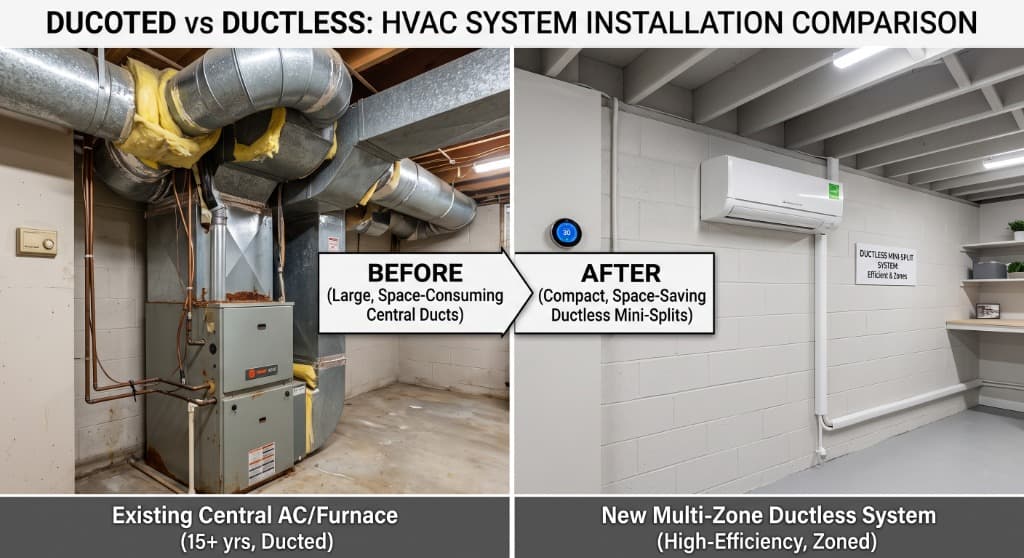
Ducted vs. Ductless Mini-Splits: Concealed Architecture & Multi-Zone Thermal Comfort
Architectural integration of mini-split systems: concealed slim-duct air handlers, branch box refrigeration, line set concealment, and individual room zoning.
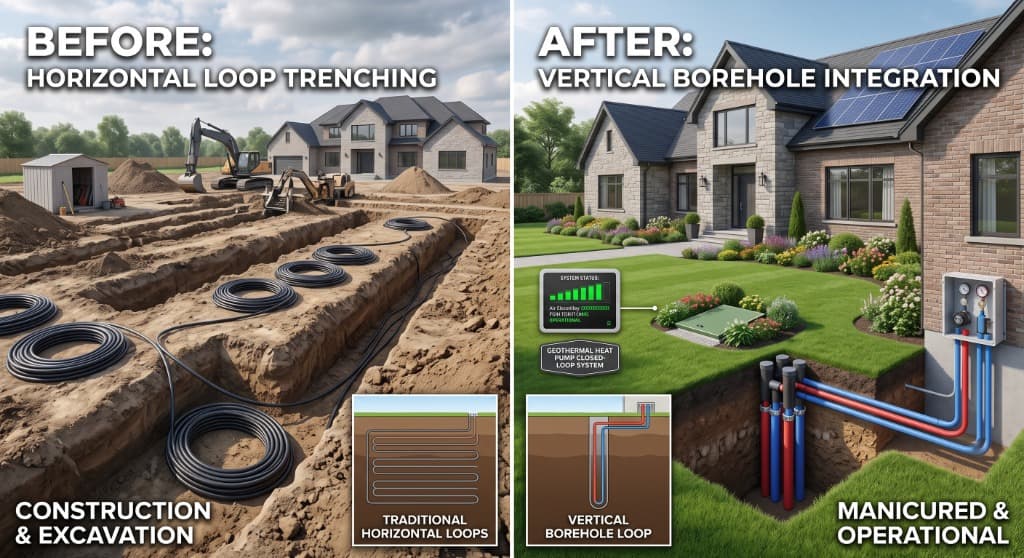
Geothermal Ground-Source Heat Pumps: Closed-Loop Borehole Physics & 30-Year ROI
Complete engineering guide to residential geothermal heat pumps: vertical borehole loops, COP 4.5+ thermodynamic efficiency, drilling costs, and federal tax credits.